Rated 4.9/5 from 345 Google reviews
Agentic AI course in Bangalore
Agentic AI engineering is the skill companies hire for now
3.5 months · Weekend or weekday batch · Offline or online
- 1:15 mentor to learner
- Mentors who build for Fortune 500
- 50+ AI tools, hands-on
- Placement support, no deadline

Why now
Chat models were the warm-up. AI Agents are what companies are building now.
The market has moved from writing prompts to building AI systems that plan, call tools and finish work.
- 84%
of developers already use AI tools at work
Stack Overflow - 80%
of engineers must upskill in AI by 2027
Gartner - ~40%/yr
growth in demand for AI skills in India
NASSCOM
The skill is new enough that supply is still thin. That gap is where the offers are, and it closes a little every month you wait.
Figures are indicative, drawn from public industry reports.
Is this you
Who should join this AI agents course?

- Software developers
- Backend and full-stack engineers
- Data and analytics professionals
- QA, DevOps and cloud engineers
- CS, IT and AI-ML students
- B.E and B.Tech freshers
- Automation and RPA professionals
- Product and operations folks
Are you one of them? Then this course is for you.
- You have used AI tools at work for two years and now you want to build the systems yourself.
- You are a fresher from CS, IT or AI-ML and you want your first job in AI engineering.
- Some of you want to automate business workflows with tools like n8n. Some want to write agent code in Python. Both fit here.
- You have never written Python. The course opens with Python basics, so there is no prerequisite to clear before joining.
- Your current work is maintenance and tickets, and you can see where that road ends. You want a career change now.
If even two of these sound like your week, this batch is built for you.
Starting fresh
Never built an AI agent before? That is exactly where most of our learners start.
Nobody walks in knowing orchestration or multi-agent design. We start at the beginning and the pace is set by the room, not by a syllabus clock.

- 01
Python from scratch
We open with Python fundamentals. If you have never written a loop in your life, you will still keep pace with the batch.
- 02
Doubts cleared in class
At a 1:15 ratio you can stop the class and ask. Mentors stay back after the session when a topic needs one more pass.
- 03
You build every week
Small builds from week one. By the time agents arrive, writing code, breaking it and fixing it already feels normal to you.
- 04
Mentors who ship this
Your mentors build AI systems for Fortune 500 companies. You are learning the workarounds from people who hit these problems on a Monday morning.
Start with Python basics. Finish with agents running on their own.
Where our learners work, across our programs
In nine-plus years, 10,000+ professionals from 30+ countries have trained with us. These are some of the companies they work at today.

























Learn from industry AI experts who build AI for Fortune 500 companies
Not academicians, not full-time trainers. Practitioners who build production AI systems and are passionate about teaching and AI career transformation.

Ramesh Krishnan
20+ YEARS EXPERIENCEAI/ML Senior Manager

Kishore Vutukuri
20+ YEARS EXPERIENCEEnterprise AI Architect

Suresh Pasumarthi
25+ YEARS EXPERIENCEAI Solutions, Product Head

Ravindra Sonawane
15+ YEARS EXPERIENCESenior AI Scientist

Anirudh Ravishankar
7+ YEARS EXPERIENCESenior AI Engineer

Ganesh Jathar
5+ YEARS EXPERIENCEAI Engineer

Tushar Tiwary
4+ YEARS EXPERIENCEAI Engineer

Shaury Srivastav
4+ YEARS EXPERIENCEAI/ML Engineer
How BlueTick compares with other agentic AI courses
Most agentic AI courses cover the same topic list. The difference shows in what you can build alone afterwards.
| Typical online course | BlueTick AI Academy | |
|---|---|---|
| Teaching | Pre-recorded videos you watch alone | Live classes with a working mentor |
| Batch size | Hundreds of learners in one thread | 1:15 mentor to learner ratio |
| Mentors | Trainers who only teach full time | Practitioners building AI systems for Fortune 500 |
| Syllabus | Prompting and a tour of tools | Orchestration, tool-use, multi-agent systems, deployment |
| Practice | Notebook demos that stop at output | Agents you deploy, then improve |
| Doubts | Raise a ticket, wait a day | Ask in the room, same minute |
| After the course | A certificate and a job board link | Complete placement support, for as long as needed |
| Fees | Pay the full amount upfront | Transparent fees with easy no-cost EMI |
Your roadmap
3.5 months, start to your first agent in production
Every phase builds on the last. Python first, then AI foundations, then agents that plan, call tools and run on their own.
Phase 1
Foundation
- Python
- AI Overview
- AI Coding
Phase 2
The Engine
- GenAI Foundation
Phase 3
Knowledge & Autonomy
- RAG
- Agentic AI
- MCPs & ADKs
Phase 4
Production
- AI Evals & LLMOps
- Multi-modal CrewAI
- n8n Automation
- Voice Agents
Phase 5
Advanced + Capstone
- Advanced Learning
- Design Thinking
- Capstone
Optional
- Machine Learning
- SQL for Interviews
- DSA for Interview Prep
The syllabus
A syllabus most agentic AI courses have not caught up with
LangChain, LangGraph, LlamaIndex, CrewAI, GraphRAG, n8n and MCP. You learn the stack hiring managers are asking about this year, not the one that trended two years ago.
3.5 months · Weekend batch Sat & Sun 10 AM to 2 PM · Weekday batch Mon to Fri 9 AM to 11 AM
- M11 / 18
AI Overview
- AI vs ML vs Deep Learning vs GenAITHEORY
- Generative AI vs traditional AI, and when each fitsTHEORY
- Enterprise AI maturity curveTHEORY
- The modern AI stack, from models to apps and agentsTHEORY
- Where GenAI, RAG and agents fit in the bigger pictureTHEORY
- Real use cases in banking, retail, healthcare, ITTHEORY
- Build vs buy: how enterprises actually adopt AITHEORY
- The AI engineer role and the career paths it opensTHEORY
- Ethics and responsible AITHEORY
- M22 / 18
Python for AI/ML
- Setting up a clean Python environmentPRACTICAL
- Python fundamentals, even if you have never codedCODE
- Building REST APIs with FastAPICODE
- Building interactive web apps with StreamlitCODE
- OOP concepts with classes and objectsCODE
- Data handling with Pandas and NumPyCODE
- Data visualisation with Matplotlib and SeabornCODE
Tools and frameworks
- Python
- Pandas
- NumPy
- Matplotlib
- Seaborn
- FastAPI
- Streamlit
You’ll walk out with
AI Text Summarization Assistant, a working web app you can demo in interviews.
- M33 / 18
AI Coding
- Coding with Claude, Cursor and GitHub CopilotCODE
- Choosing the right AI coding tool for the taskPRACTICAL
- Context management and instruction filesPRACTICAL
- Prompting patterns for code generationPRACTICAL
- Spec-driven developmentPRACTICAL
- Reviewing and refactoring AI-generated codeCODE
- Writing and running tests with AICODE
- Generating documentation from your codebasePRACTICAL
- Debugging with AICODE
Tools and frameworks
- Cursor
- Claude
- GitHub Copilot
You’ll walk out with
A working application built end to end using Claude.
- M44 / 18
GenAI & LLM Foundations
- How LLMs work, Transformers explained simplyTHEORY
- Reasoning and Chain-of-Thought modelsTHEORY
- Prompt engineering for the output you needPRACTICAL
- Prompt evaluation and optimisationPRACTICAL
- Working with OpenAI, Gemini and Claude APIsCODE
- Diffusion models for image generationPRACTICAL
Tools and frameworks
- LangChain
- OpenAI API
- Gemini API
- Claude API
You’ll walk out with
A working chatbot powered by an LLM API, the foundation you extend in every later module.
- M55 / 18
RAG (Retrieval Augmentation)
- RAG architecture end to endTHEORY
- Vector embeddings, chunking and indexingCODE
- Retrieval and rerankingCODE
- Vector databases: Chroma, Pinecone, WeaviateCODE
- LlamaIndex for production RAGCODE
- Graph RAG and evaluation with RAGASPROJECT
Tools and frameworks
- LlamaIndex
- ChromaDB
- Pinecone
- Weaviate
- RAGAS
- Graph RAG
You’ll walk out with
Enterprise Document Q&A System, a production retrieval system that answers questions over your own documents.
- M66 / 18
Agentic AI
- Agents: LLM + tools + memory + planningTHEORY
- Agent workflows and orchestrationPRACTICAL
- Building agents with LangGraphCODE
- SQL Agent that queries databases in plain EnglishCODE
- Context engineering: why agents failPRACTICAL
- Agentic RAG and agent memoryCODE
- Multi-Agent Systems with CrewAI and MCPPROJECT
Tools and frameworks
- LangGraph
- CrewAI
- MCP
- LangChain
You’ll walk out with
SQL Agent plus Multi-Agent Enterprise Data Assistant, your portfolio centrepiece.
- M77 / 18
Capstone Project
- Scope a real corporate use case into an AI solution designTHEORY
- Build a production RAG pipeline over enterprise documents with LangChainCODE
- Design a multi-step Agentic AI workflow in LangGraphCODE
- Wire agents to tools, memory and retrievalCODE
- Orchestrate the agent and RAG systems into one Python applicationCODE
- Test, debug and harden the system for real-world inputsPRACTICAL
- Package and present it as an interview-ready portfolio projectPROJECT
Tools and frameworks
- LangChain
- LangGraph
- Python
You’ll walk out with
An Agentic AI + RAG system built on a real corporate use case, your portfolio centrepiece.
- M88 / 18
AI Evals & LLMOps
- AI evaluation: knowing if your AI actually worksTHEORY
- LLM-as-Judge evaluation techniquesPRACTICAL
- Tracing and observability in productionPRACTICAL
- Guardrails against hallucinations and unsafe outputCODE
- AI task orchestration with n8nPRACTICAL
- Cutting LLM cost without losing qualityPRACTICAL
Tools and frameworks
- Phoenix
- Opik
- LangSmith
- n8n
- Zapier
- Make
You’ll walk out with
Customer Support Agent with evaluation and observability, a production-ready system recruiters recognise.
- M99 / 18
Multi-modal AI using CrewAI
- Multi-modal LLMs: reasoning over text, images and audio togetherTHEORY
- Designing a crew of role-based agents with CrewAICODE
- Coordinating tasks, roles and delegation across a multi-agent crewPRACTICAL
- Feeding agents multi-modal inputs and toolsCODE
- Building a pipeline that reads images and documentsCODE
- Sharing memory and context between agents in a crewCODE
- A working multi-modal, multi-agent application with CrewAIPROJECT
Tools and frameworks
- CrewAI
- OpenAI API
- Gemini API
You’ll walk out with
A multi-modal AI crew that reasons over text, images and audio together.
- M1010 / 18
Workflow Automation with n8n
- Workflow automation fundamentals and where it pays offTHEORY
- Building AI workflows visually in n8nPRACTICAL
- Triggering workflows from events, webhooks and schedulesCODE
- Connecting LLMs and agents inside an n8n workflowCODE
- Integrating business tools: email, Sheets, CRMs and APIsCODE
- Adding branching, error handling and retries to automationsPRACTICAL
- An end-to-end automated AI workflow built in n8nPROJECT
Tools and frameworks
- n8n
- Zapier
- Make
You’ll walk out with
An end-to-end AI automation that triggers, orchestrates and acts on its own in n8n.
- M1111 / 18
MCPs & Google ADKs
- What MCP is and why it standardises tool accessTHEORY
- Connecting AI to any data source with MCPCODE
- Building and running your own MCP serversCODE
- Using Google ADKs to build production agentsCODE
- Exposing tools, files and APIs to your agents safelyPRACTICAL
- Composing multiple MCP servers into one agent systemCODE
- A data assistant that talks to your own sources via MCPPROJECT
Tools and frameworks
- MCP
- Google ADK
You’ll walk out with
A local file and data assistant that reaches your own sources through MCP.
- M1212 / 18
Design Thinking with AI
- Design-thinking fundamentals for AI productsTHEORY
- Empathising with users and framing the real problemTHEORY
- Ideating AI solutions that fit the use casePRACTICAL
- Mapping a problem to the right pattern: RAG, agents or automationPRACTICAL
- Rapid prototyping of AI features with StreamlitCODE
- Testing and validating ideas with real usersPRACTICAL
- A validated AI product concept, prototyped end to endPROJECT
Tools and frameworks
- Streamlit
You’ll walk out with
A validated AI product concept taken from problem framing to a working prototype.
- M1313 / 18
Voice Agents
- How voice agents work: speech-to-text, LLM, text-to-speechTHEORY
- Building natural voice interfaces with ElevenLabsCODE
- Transcribing and understanding user speechCODE
- Driving a voice agent with an LLM and toolsCODE
- Adding memory and turn-taking to a conversationPRACTICAL
- Handling latency, interruptions and real-time flowPRACTICAL
- A working voice agent that speaks and listensPROJECT
Tools and frameworks
- ElevenLabs
- LangGraph
You’ll walk out with
A production-style voice agent that listens, reasons and replies in natural voice.
- M1414 / 18
Advanced Learning
- Agent-to-Agent (A2A) protocols for multi-system collaborationTHEORY
- Designing agents that discover, message and delegate to each otherCODE
- When to fine-tune vs prompt vs retrieveTHEORY
- LLM fine-tuning with LoRA and QLoRACODE
- Parameter-efficient fine-tuning with PEFTCODE
- LLM cost optimisation: cutting spend without losing qualityPRACTICAL
- Model selection, caching and token strategies for productionPRACTICAL
Tools and frameworks
- LoRA
- QLoRA
- PEFT
You’ll walk out with
A fine-tuned, cost-optimised model plus a multi-agent setup that collaborates over A2A protocols.
- M1515 / 18
Machine Learning (Optional. Live Online)
- Regression, Decision Trees, Random Forest, XGBoostCODE
- Overfitting, bias and variance, explainabilityTHEORY
- Unsupervised: K-Means, DBSCAN, PCACODE
- Computer Vision and Object Detection (YOLO)PROJECT
- Model evaluation and cross-validation metricsPRACTICAL
- Forecasting: time series, ARIMA, AutoGluonCODE
- Deep Learning: Neural Nets, CNN, RNNCODE
- MLOps with MLflow and model monitoringPRACTICAL
Tools and frameworks
- scikit-learn
- XGBoost
- LightGBM
- AutoGluon
- TensorFlow
- PyTorch
- YOLO
- MLflow
You’ll walk out with
Classical-ML portfolio pieces: an object-detection model (YOLO) and a time-series forecasting model, alongside a monitored, deployed model.
- M1616 / 18
SQL (Only for Freshers)
- How SQL thinks: execution order and a 6-step query frameworkTHEORY
- SELECT, filtering and sorting to slice any datasetCODE
- JOINs and aggregations across multiple tablesCODE
- Window functions for ranking, running totals and comparisonsCODE
- CTEs and subqueries to break down complex questionsCODE
- Interview patterns: Top-N, dedup and running totalsPRACTICAL
- A timed mock SQL round on real interview questionsPROJECT
Tools and frameworks
- PostgreSQL
- SQLAlchemy
- LeetCode patterns
You’ll walk out with
A solved bank of interview SQL patterns plus a timed mock round you can repeat before every interview.
- M1717 / 18
DSA for Interview Prep (Only for Freshers)
- Arrays and two pointers: prefix sum, Kadane's, sliding windowCODE
- Binary search on answers and index spacesCODE
- Stacks, queues and linked lists, including LRU cacheCODE
- Trees and recursion with DFS and BFS traversalsCODE
- Backtracking for combinations, permutations and subsetsCODE
- Graphs, heaps and dynamic programming fundamentalsCODE
- Blind 75 walkthrough and an online-assessment strategyPROJECT
Tools and frameworks
- Python
- Blind 75
- LeetCode patterns
You’ll walk out with
A worked Blind 75 pattern set plus an OA and mock-round strategy that turns coding rounds into a formality.
- M1818 / 18
Capstone Project & Interview Prep
- Architecting a multi-modal AI system end to endPRACTICAL
- Connecting tools and data with MCPs and ADKsCODE
- Adding a voice-agent interface to your systemCODE
- Automating the workflow with n8nCODE
- Integrating retrieval, agents and automation into one productPROJECT
- Building your portfolio and project walkthroughPROJECT
- Mock interviews and AI-engineer interview prepPRACTICAL
Tools and frameworks
- MCP
- Google ADK
- ElevenLabs
- n8n
You’ll walk out with
A multi-modal AI system spanning MCPs, ADKs, voice and n8n automation, plus an interview-ready portfolio.
Capstone
One autonomous workflow, built and deployed by you
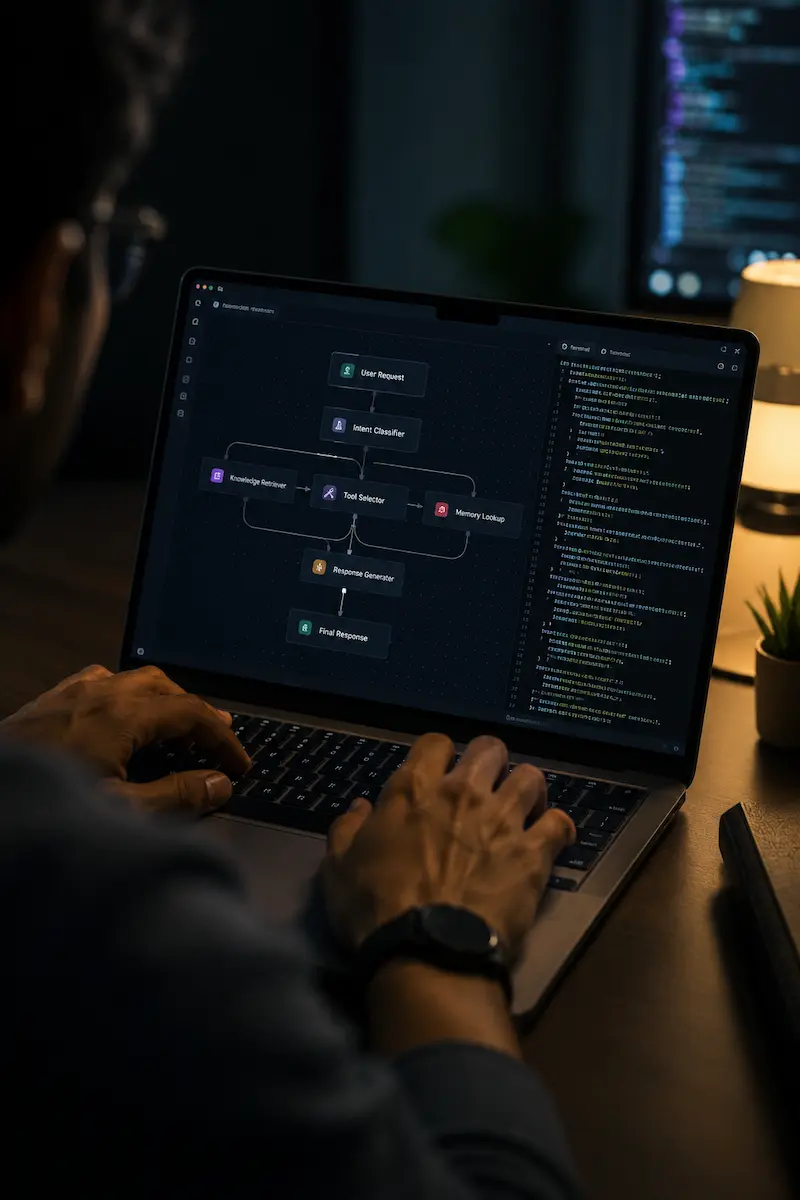
You pick a real business process. You ship the agent that runs it.
Pick a real process
Support triage, invoice checks, lead research, report generation. You choose a process a company actually pays people to do every week.
Build the full agent
Planning, tool calls, memory, error handling, human approval where it matters. It runs end to end without you clicking anything.
Ship it and prove it
- Deployed and running, not a notebook
- Evaluated on real inputs
- Documented for your interviews
You leave with an agent you can demo, not slides about one.
50+ AI tools, taught hands-on
Every tool below is taught by building with it, not just named in a slide.













+ 40 more, taught hands-on across your track
The payoff
What an agentic AI course is worth to your salary and your next role
Companies are paying a premium for people who can build these systems, because very few people can.

- 62%higher offers for people with Gen AI skillsScaler
- ~56%pay premium reported for AI skillsPwC
- 1M+AI professionals India needs in the coming yearsMeitY
- <3%of 1.5M graduates have real AI skills todayNASSCOM
Demand is loud and supply is thin. That is a short window, and it favours whoever starts early.
Figures are indicative, drawn from public industry reports.
Why BlueTick
Four things that change your learning speed

Live, never recorded
Every session is taught live by a mentor in the room. Nothing is pre-recorded, so the class moves at your batch's pace.
1:15 mentor ratio
Fifteen learners to one mentor. Your bug gets looked at the same day, not left for a forum thread to solve.
Practitioners, not presenters
Mentors build AI systems for Fortune 500 companies. You get the fixes that work in production, not just the happy path.
50+ AI tools, hands-on
You use them hands-on. By the end, choosing the right tool for an agent task is a habit.
Your portfolio
Projects you can actually show
Eight builds through the course, each one a working piece of an AI system. This is what you open in an interview when they ask what you have built.
Python for AI/ML
AI Text Summarization Assistant
A deployed web app that condenses long documents, built in your first weeks so you have something demoable almost immediately.
- Python
- FastAPI
- Streamlit
GenAI & LLM Foundations
LLM-Powered Chatbot
A chatbot running on a live LLM API. Every agent you build later starts from this same working foundation.
- LangChain
- OpenAI API
- Claude API
RAG (Retrieval Augmentation)
Enterprise Document Q&A System
A production retrieval system answering questions over your own documents, with the retrieval quality actually measured rather than assumed.
- LlamaIndex
- ChromaDB
- Pinecone
- RAGAS
Agentic AI
SQL Agent + Multi-Agent Data Assistant
Your centrepiece: agents that query databases in plain English and hand work to each other until the task is finished.
- LangGraph
- CrewAI
- MCP
Capstone Project
Agentic AI + RAG Corporate Build
An agent and retrieval system scoped to a real corporate use case, hardened against messy inputs and packaged for interviews.
- LangChain
- LangGraph
- Python
AI Evals & LLMOps
Support Agent with Evals & Observability
A monitored, guardrailed support agent. This is the difference between a demo that impresses and a deployment that survives.
- Phoenix
- Opik
- LangSmith
- n8n
MCPs & Google ADKs
Local File & Data Assistant
A private assistant that reaches your own files and data sources through the Model Context Protocol, no custom glue required.
- MCP
- Google ADK
Capstone Project & Interview Prep
Multi-modal Capstone with Voice & Automation
One autonomous system spanning tools, voice and n8n automation, plus the documented portfolio you walk into interviews with.
- MCP
- Google ADK
- ElevenLabs
- n8n
Complete placement support, for as long as you need it
Support does not stop on the last day of class. You stay with us through applications, interviews and offers, however long that takes.

Resume rebuild
We rewrite your profile around AI agent work, so recruiters see a builder and not a maintainer.
Portfolio review
Your capstone and projects get cleaned up, documented and made easy for a hiring manager to open.
Mock interviews
Technical rounds with mentors who take these interviews at work. Honest feedback, as many rounds as needed.
Referrals and openings
We share relevant openings from our network and hiring partners, and keep sharing after your course ends.
No expiry date on the help you get here.
The same engineer, two different offers
The gap is not about years of experience. It is about whether you can build systems that run without a human.
- up to 2×salary increases 2 timesFresher0-2 yrs
- up to 1.9×salary increases 1.9 timesMid-level3-7 yrs
- up to 1.6×salary increases 1.6 timesSenior8+ yrs
Ranges reflect roles in India across product companies, services firms and startups.
Figures are indicative of current market ranges. Actual salaries depend on your role, skills and performance.
Where you learn
Learn in Indiranagar, or join the same class online
Weekend batch runs Saturday and Sunday, 10 AM to 2 PM. Weekday batch runs Monday to Friday, 9 AM to 11 AM. Pick the one your work allows.
Offline in Indiranagar
Walk in, sit with your batch, debug on the same screen as your mentor. One minute from Indiranagar Metro, with parking sorted.
Online, same live class
Not a recording and not a separate batch. You join the same session, ask the same questions, at the same time as the room.

2nd Floor, 545 CMH Road, Indiranagar, Bengaluru 560038. One minute from Indiranagar Metro. Free parking available.
Same mentor, same batch, whichever way you attend.
Upcoming agentic AI training batches in Bangalore
Seats are capped at fifteen for every batch. When a date is full, it is full.
- Oct 10Sold out
- Next batches open
Oct 25
Filling fast- Weekend: Sat & Sun, 10 AM to 2 PM
- Weekday: Mon to Fri, 9 AM to 11 AM
- Offline or online, same live class
- Dec 12Available
Common questions
What is an agentic AI course?
An agentic AI course teaches you to build AI systems that decide and act on their own, instead of only answering prompts. You learn how an agent plans a task, breaks it into steps, calls tools and APIs, holds memory across those steps, checks its own output and recovers when something fails. At BlueTick, that means orchestration frameworks, tool-use patterns, multi-agent design, retrieval, evaluation and deployment, taught live over 3.5 months. You start from Python basics, so there is no entry test. You finish with a working agent that runs a real workflow end to end, not a chatbot demo.
Is agentic AI mature enough to learn now?
Yes, and the timing is the point. Agents moved out of research and into production over the last two years. Companies now run them for support triage, document processing, research, QA and internal operations. The frameworks have settled enough to teach properly, and standards like MCP have made tool connections far less messy than they were. The honest part is that the stack still changes, which is why we update the syllabus every batch and teach the ideas under the tools. Gartner expects 80% of engineers to upskill in AI by 2027. Waiting for it to feel settled means arriving with everyone else.
Is this just a GenAI course relabelled?
No. A generative AI course teaches you to get good output from a model. This course teaches you to build systems that use models to complete work without a human clicking through each step. The overlap is roughly the first few weeks, prompting and retrieval, because you cannot build agents without them. After that the syllabus goes somewhere else entirely: orchestration graphs, tool calling, state and memory, multi-agent handoffs, guardrails, evaluation and deployment. If you already know generative AI well, that early portion moves quickly for you. If you want the model-first path instead, our generative AI course covers it properly.
Do I need coding experience to join this AI agents course?
No prerequisite is needed. The course opens with Python fundamentals and builds from there, so people who have never written a line of code join every batch and keep up. What helps more than coding background is logical thinking and steady practice between sessions. If you already write Python daily, you will find the first phase easy and can use that time to go deeper on projects. Mentors adjust because the batch is capped at fifteen learners. Freshers from CS, IT and AI-ML backgrounds, and working engineers with two to eight years, sit in the same room and both get value.
How long is the agentic AI training and what does it cost?
The programme runs 3.5 months. You pick either the weekend batch on Saturday and Sunday from 10 AM to 2 PM, or the weekday batch from Monday to Friday, 9 AM to 11 AM. Both are live and mentor-led, and both are available offline at our Indiranagar campus or online in the same session. Fees are transparent and shared upfront with no hidden add-ons, and easy no-cost EMI options are available. Talk to our team for the current fee and EMI plans for your batch date, since the number changes with the plan you choose.
Will this course help me get placed in an AI role?
You get complete placement support, for as long as you need it. That covers rewriting your resume around agent-building work, cleaning up your capstone and projects so a hiring manager can open them, mock technical interviews with mentors who take these interviews at work, and sharing relevant openings from our network. Support does not stop when the batch ends. What we do not do is promise a placement percentage or a guaranteed job, because no honest academy can control hiring decisions. What we can control is that you walk in with a deployed agent and can explain every design choice in it.
Can I do this agentic AI course in Bangalore online instead?
Yes, and it is the same class, not a separate online track. Online learners join the live session with the offline batch, ask questions in real time and work on the same builds. Nothing is pre-recorded. Many of our learners come from 30+ countries and attend this way. If you are in Bangalore, the Indiranagar campus is one minute from the metro with free parking, and most people prefer sitting in the room for debugging sessions. You can also switch between the two during the course if your schedule changes. Just tell your mentor.
Which frameworks and tools will I learn in this course?
You work hands-on with the stack companies are hiring for right now: LangChain and LangGraph for orchestration, LlamaIndex and GraphRAG for retrieval, CrewAI for multi-agent setups, n8n for workflow automation, and MCP for connecting agents to tools and data. Around that you use vector databases, evaluation tooling and deployment services, plus more than 50 AI tools across the full programme. The frameworks will keep changing, so mentors teach the pattern underneath each one. Once you understand orchestration and tool-use properly, picking up whatever ships next year takes a weekend, not a course.
The complete guide to an agentic AI course
An agentic AI course teaches you to build software that thinks in steps and acts on its own. If you are weighing an agentic AI course against a generative AI one, or wondering whether the field is ready, this guide covers the syllabus, the stack, the jobs and the honest trade-offs.
What is an agentic AI course, and what does it really teach?
An agentic AI course is a programme that teaches you to build AI systems which plan, decide and act with limited human input. The difference from ordinary AI training is the word "act". A model answers. An agent finishes work.
In practice, the syllabus has six pillars.
- Orchestration, which is how you structure the steps an agent takes and the paths it can follow.
- Tool-use, which is how the agent calls APIs, databases, browsers and internal systems.
- Memory and state, so the agent remembers what it did three steps ago.
- Multi-agent design, where several specialised agents hand work to each other.
- Evaluation, because an agent that fails silently is worse than no agent.
- Deployment, so the thing runs on a server and not on your laptop.
A good course teaches all six with code. A weak one stops after prompting and calls it agentic. That single difference is what you should test every syllabus against.
Agentic AI versus generative AI, explained simply
Here is the cleanest way to see the split.
- Generative AI produces content when you ask. You write a prompt, you get text, code or an image. You stay in the loop for every step.
- Agentic AI produces outcomes. You give a goal, and the system plans the steps, picks tools, runs them, checks results and retries when something breaks.
An example makes it obvious. Generative AI drafts a reply to a customer email. An agentic system reads the inbox, classifies the complaint, pulls the order record from your database, checks the refund policy, drafts the reply, routes anything above a threshold to a human, and logs the whole thing.
The skills overlap at the base. You need prompting, retrieval and model behaviour either way, which is why our generative AI course shares its early foundation with this one. After that base, the two diverge sharply. One goes deeper into content quality. The other goes into systems engineering.
Why agentic AI courses are in demand this year
Three things happened together. Model reliability improved enough for multi-step tasks. Orchestration frameworks matured past the experimental stage. And standards like MCP made connecting an agent to real company tools far simpler than the custom glue everyone wrote earlier.
The result is that agent projects moved from innovation labs into normal engineering roadmaps. Support automation, document processing, sales research, internal reporting and QA are the common first use cases. Every one of them needs somebody who can build and maintain the system.
That somebody is in short supply. NASSCOM puts AI skill demand growth at around 40% a year, while MeitY estimates only about 16% of Indian IT professionals are AI-skilled. The people who close that gap early get to define these systems inside their companies rather than inherit them. That is the real career argument, and it explains why agentic AI courses fill faster than most other technical programmes right now.
Coding path or an AI automation course? Pick honestly
Not everyone entering this field wants to write Python for eight hours a day, and pretending otherwise wastes people's money.
Two routes exist. The first is the automation route, built on visual workflow tools like n8n plus AI nodes. You connect systems, add decision logic and ship useful automations without deep coding. It suits operations, marketing, support and business analyst roles, and it delivers value in weeks.
The second is the engineering route, where you write agents in Python with LangGraph or CrewAI, control memory and error handling yourself, and deploy them properly. It suits developers and takes longer to get good at, but the ceiling is much higher and so is the pay.
Our programme covers both, in that order, so nobody gets locked out. An AI automation course inside a broader syllabus works well because the automation-first learner still understands what is happening underneath, and the developer gets a fast tool for prototyping before writing code.
How to choose an agentic AI course in Bangalore
Bangalore has no shortage of options, so use a checklist instead of a brochure.
- Ask whether classes are live or recorded, and who exactly teaches them. A practitioner who builds these systems for large companies will teach you the failure modes; a full-time trainer usually teaches the documentation.
- Ask the batch size, because doubt clearing is where technical courses live or die.
- Ask what gets deployed by the end, and request to see a past learner's capstone repository.
Then check the syllabus for the six pillars from section one. If evaluation and deployment are missing, the course ends where the hard part begins.
Finally, ask what happens after the last class. Placement help that expires in thirty days is not placement help. If you are comparing options across the city, our page on the best AI course in Bangalore lays out the same comparison across formats and budgets.
Is an agentic AI full course worth it for a working developer?
For most working developers with two to eight years of experience, yes, and the reason is not the syllabus. It is the sequencing.
You can learn every one of these topics free on the internet. What you cannot easily get alone is a structured order, somebody senior looking at your code, and the pressure of a batch that keeps you moving when work gets heavy. Most self-taught attempts die around week five, usually at the point where the tutorials stop matching the docs.
An agentic AI full course fixes that with live sessions, a fixed weekly rhythm and a mentor who has already hit the bug you are stuck on. Over 3.5 months, weekends only, that is a manageable commitment against a real career shift.
The counter-case is fair too. If you already ship agents at work and just need depth on one framework, a course is overkill. Buy the book instead.
What an AI agent course covers, phase by phase
The shape of a serious AI agent course is fairly consistent, whichever academy you pick.
- The first phase is foundations. Python, data handling, and enough machine learning to know what the model is actually doing. Learners who already code move through this quickly.
- The second phase is language models in practice. Prompting properly, embeddings, vector search, retrieval-augmented generation, and where each of these breaks.
- The third phase is agents. Tool-use, function calling, orchestration graphs, memory, multi-agent coordination, MCP servers, guardrails and human-in-the-loop checkpoints.
- The fourth phase is production. Evaluation harnesses, cost and latency control, logging, monitoring, and deployment.
- The last phase is the capstone and interview preparation.
Our module structure follows the same backbone as our AI and ML course, with the machine learning depth kept optional for learners who only want the agent track.
How agentic AI training prepares you for real interviews
Interviews for agent roles have settled into a recognisable pattern, and it is not a quiz on framework syntax.
You get asked to design a system. Something like: build an agent that processes vendor invoices. Then come the follow-ups. How does it handle a malformed PDF? What stops it from approving a fraudulent invoice? How do you know it is working next month? What does each run cost?
Nobody answers these well from theory. You answer them well from having built something and watched it fail. That is why agentic AI training should be project-heavy rather than lecture-heavy, and why your capstone matters more than your certificate.
We run mock interviews on exactly this format, with mentors who sit on the other side of these panels at work. Combined with a documented, deployed project, it changes how the conversation goes. For the full hiring picture, see our AI course in Bangalore with placement page.
Where an applied AI course fits your longer career plan
An applied AI course sits between two extremes that both disappoint people.
At one end are theory-first programmes, heavy on mathematics and papers, light on shipping. They suit research careers and frustrate everyone else. At the other end are tool tours, forty hours of clicking through products, which feel productive and leave you unable to build anything unaided.
Applied sits in the middle. You learn enough theory to make good design decisions, then spend most of your hours building, breaking and deploying. That is the profile hiring managers want for engineering roles, because they are hiring somebody to ship, not to publish.
Practically, this means your week has reading, but your weekend has a build. It means you will be uncomfortable in week six when your first agent loops forever and burns tokens. Then you will fix it, and that fix becomes an interview story. Career-wise, this is the fastest route from where you are to an AI engineer role.
The stack worth learning right now, and what to ignore
Frameworks churn, so learn them in order of durability.
Durable ideas first: orchestration, tool-use, retrieval, memory, evaluation. These will outlive every library on this list.
Then the current tooling.
- LangChain for building blocks and LangGraph for controlled, stateful workflows.
- LlamaIndex for retrieval, with GraphRAG when relationships between documents matter more than similarity.
- CrewAI for multi-agent role setups.
- n8n for workflow automation and quick prototypes.
- MCP for connecting agents to tools, files and internal systems through one standard interface.
Around these, a vector database, an evaluation tool and one deployment platform.
What to ignore: chasing every new framework announced on social media, and any tutorial older than about a year, since the APIs have usually changed under it.
We teach more than 50 AI tools across the programme, but the point is never the tool count. It is that you can read a new framework's docs on Monday and ship with it by Friday.
Jobs, roles and salaries for agent engineers in India
The job titles are still stabilising. You will see AI engineer, agent engineer, LLM engineer, applied AI engineer, AI automation specialist and forward-deployed engineer, often describing similar work.
The pay picture is where it gets interesting. Scaler reports 62% higher offers for candidates with generative AI skills, and PwC found a pay premium of roughly 56% for AI skills. Current market ranges in India sit around ₹6-12 LPA for freshers with these skills, ₹18-28 LPA at mid level and ₹28-45 LPA for senior engineers.
Two cautions. First, these are market ranges and your actual offer depends on your role, company and how well you interview. Second, the premium exists because supply is short. NASSCOM notes that under 3% of India's 1.5 million graduates have real AI skills. That gap will narrow. Early movers capture the widest part of it.
Figures are indicative, drawn from public industry reports.
Starting from zero: your first ninety days
If you have never written Python, here is what the first ninety days actually look like.
- Weeks one to four are syntax, data structures and small scripts. It feels slow. Everybody feels behind. Then something clicks, usually around week three, and reading code stops being decoding.
- Weeks five to eight are models and retrieval. You build your first useful thing, normally a system that answers questions over your own documents. This is the stage people show their friends.
- Weeks nine to fourteen are agents. Tool calls, orchestration, memory, multi-agent handoffs. Your agent will loop, hallucinate a tool name and spend money doing nothing useful. Fixing that is the actual learning.
- The final weeks are your capstone and job preparation.
The only thing that decides your outcome is whether you build between classes. If you are still deciding where to begin, our AI course for beginners is the gentler entry point.
The engineers building AI agents today are the ones getting called for interviews tomorrow
Talk to our team, see the full syllabus, and decide with the facts in front of you. No pressure either way.
Fifteen seats a batch. The next date is already filling up fast.