
AI Solutions Specialist
Spot the business problem, design the AI-powered fix, and run the rollout. The bridge between your team and AI.
Rated 4.9/5 from 345 Google reviews
Meant for Working Professionals. Latest 50+ Gen AI Tools.
3 months · Weekends or weekdays · Offline or online
Read this first

You can become the most sought-after analytics person in your domain without writing a single line of code.
The future of work does not need more engineers. It needs people who can put AI to work on real business problems. That is exactly what this course trains you to do.
Companies already have engineers. What they are short of is finance, ops and business people who can run conversational analytics on their own numbers. That mix is rare, and it is well paid.
Career outcomes
None of these need an engineering degree. They need business knowledge plus what an AI analytics course gives you: the ability to put AI on your own numbers.

Spot the business problem, design the AI-powered fix, and run the rollout. The bridge between your team and AI.
Turn business needs into AI use cases, check AI outputs, and present the impact to leadership.
Design, build and run AI-powered workflows across finance, operations and business teams. No code required.
Built for your function
Finance, Project Management, Operations, Data Analytics and HR each get a dedicated deep dive, taught on real tasks from those functions.

Expense audits, invoice extraction and forecast narratives, plus a data-privacy boundary so you never send the wrong information to AI. You leave with a five-prompt finance template set and a finance playbook.
Turn a messy meeting transcript into minutes and action items, a goal into a phased plan with a risk register, and raw notes into a board-ready one-pager.
Demand summaries, supplier exception emails, a ready-to-use operations SOP, and a set of scored operations use cases you can take back to your team.
Ask your data questions in plain English, let AI draft the SQL and the first-pass analysis, then verify every number and turn it into a clear dashboard and a one-page insight brief.
Draft and screen job posts, summarise CVs and policies into clear FAQs, and automate the reporting and everyday communication that HR, admin and business teams run on.
Another function?
In marketing, admin, sales or any other function, the same core skills apply directly to your work. Prompting, automation, analytics, content and governance are function-agnostic. Book a demo and we will map them to your exact role.
Market reality
AI analytics is already inside every major business function in India. The real question is whether you are the one using it.
The curriculum
Fifteen hands-on modules from AI foundations to a business-ready AI plan — each one built on your own real work. Swipe through every module below, then a four-session capstone.
Weekend or weekday batch. Offline in Indiranagar or the same live session online.
Tools and frameworks
An AI-maturity check of your own org + 3 business problems mapped to AI patterns
Tools and frameworks
A 10-prompt library for your own function + an output-evaluation checklist
Tools and frameworks
One end-to-end automation + an ROI worksheet in ₹/week
Tools and frameworks
A redesigned AI feature with a responsible-AI checklist
Tools and frameworks
A working tool, live on the internet, with your name on it
Tools and frameworks
A second, more complex automation from your own role + a 1-page runbook
Tools and frameworks
An AI Insight Brief → 3-slide stakeholder deck → live dashboard
Tools and frameworks
A demand summary, a supplier exception email, 1 ops SOP + 3 scored use cases
Tools and frameworks
A script or structured document from an IDE agent + notes on where it helped vs failed
Tools and frameworks
A 1-page AI Research Brief + a rewritten email + a LinkedIn post + your daily AI routine
Tools and frameworks
A multi-step Cowork workflow from your own role + a review checklist
Tools and frameworks
6–8 KPIs across 3 tiers + a no-code AI-metrics dashboard
Tools and frameworks
Minutes + action items from a messy transcript; a phased plan + risk register; a publish-ready SOP
Tools and frameworks
A 5-prompt Finance template set + a data-privacy boundary doc
Tools and frameworks
An AI ROI calc + use-case scoring model + 12-month governed roadmap
The capstone
Over the final four sessions you take one real challenge from your own work and build a business-ready AI Integration Proposal.

Your AI Integration Proposal includes
You present it to a review panel and walk away with a certificate of completion and something far more useful: proof you can lead AI where you work.
Across our programs, BlueTick alumni have gone on to build careers at leading MNCs, funded startups and top product teams.



























A different expert leads each module, so you always learn from someone who has actually built it.

AI/ML Senior Manager

Enterprise AI Architect

AI Solutions, Product Head

Senior AI Scientist

Senior AI Engineer

AI Engineer

AI Engineer

AI/ML Engineer
Every tool is taught hands-on, never just shown on a slide. Here are a few you'll get comfortable with. Your track covers the full stack.















.webp)
.webp)

.webp)

+ 40 more, taught hands-on across your track
Career support
We train you for exactly what AI business analyst interviews ask, so you walk in ready to crack them.
Shape the work you build in the course into a portfolio that proves what you can do.
Reposition your profile around your new AI skills so recruiters can see the value.
Practise with our AI experts until your answers and your demos land with confidence.
Real support backed by our network, for as long as you need it.
Complete placement support, for as long as you need it. Portfolio, resume, mock interviews and referrals: real help, backed by our network.
These are current market ranges, not a BlueTick promise. They show why adding AI to your role pays.
All figures in LPA (₹ lakh per year) · Source: Glassdoor, NASSCOM 2026, BusinessToday, Jan 2026.
Indicative market ranges. Actual salaries depend on your role, skills and performance.
Learn your way
Weekdays Monday to Friday, 3:30 to 5:30 PM. Or weekends Saturday and Sunday, 3 to 6:30 PM. Pick what fits your working week.

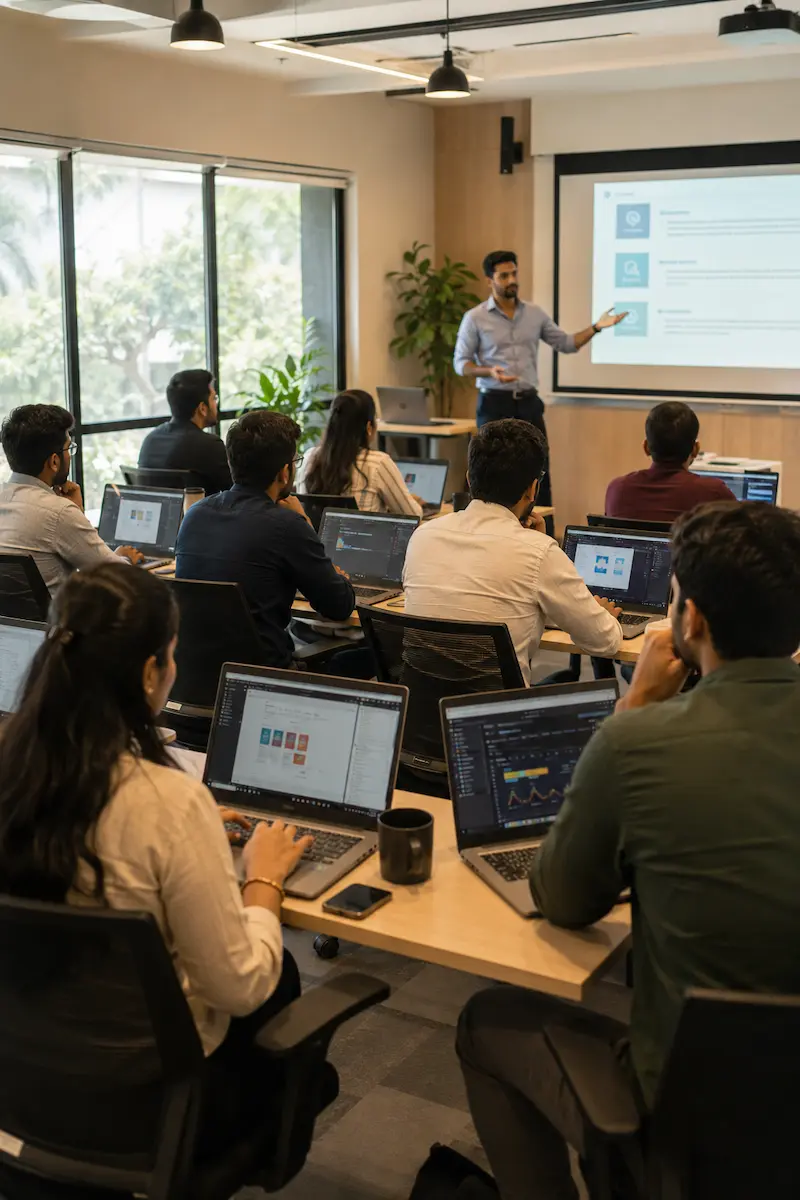
Offline at our campus
Learn in person at our Indiranagar campus, a one-minute walk from Indiranagar Metro, with free parking.
Or the same class, live online
Cannot travel? Join the very same live session online, with the same mentor and the same batch. Never a recording instead.
2nd Floor, 545 CMH Road, Indiranagar, Bengaluru 560038
Same expert mentors, same live class, whichever you choose.
Upcoming batches
The 1:15 mentor ratio means seats are capped on purpose. Here are the next batches.
Weekends, Saturday and Sunday 3 PM to 6:30 PM. Or weekdays, Monday to Friday 3:30 PM to 5:30 PM. Offline in Indiranagar or the same live session online.
Questions, answered
An AI data and business analytics course teaches you to turn business data into decisions using AI, without writing code. You learn to ask your own numbers questions in plain English, let AI draft the first pass of the analysis, then check every figure before it goes anywhere. Alongside that you learn dashboards in Power BI, prompt design, workflow automation and the governance rules that keep company data safe. At BlueTick this runs as 15 modules across 24 live sessions over 3 months, taught on the reports and spreadsheets you already handle at work.
No. There is zero coding in this course, and no SQL or Python is expected before you join. Everything is done in plain English through tools like ChatGPT, Claude, Power BI and n8n, which is how most analytics work is now done inside companies. Where a query is needed, AI drafts it and you learn to read it and verify the result, which is the skill employers actually screen for. A 1:15 mentor to learner ratio means someone is beside you when you get stuck. AI job postings for non-technical roles have grown 800% since 2022, on LinkedIn's numbers.
An AI analytics course teaches you to work with AI as your analyst, while a traditional data analytics course teaches you to do the analysis by hand. The older route puts months into Excel formulas, SQL syntax and chart building before you produce anything useful. Here you start with the business question, use conversational analytics to get a first answer in minutes, and spend your time on judgement: is this number right, what does it mean, what should the team do next. You still learn Power BI properly. The difference is that you also learn to direct AI and check its work.
You work with more than 50 Gen AI tools across the three months, and about a dozen of them daily. On the analytics side that means Power BI with Power BI Copilot, Julius AI for plain-English data questions, and dashboards you build and present yourself. For research and writing you use NotebookLM, Perplexity and Gamma. For automation you use n8n to build multi-step workflows, and Claude Cowork for agentic reporting that runs on a schedule. ChatGPT and Claude sit under all of it for prompting, analysis and AI narratives that explain what a chart is actually saying.
Yes, the whole course is built around people who are working full time. It runs for 3 months with 24 live sessions, and you pick the batch that suits your week: weekends on Saturday and Sunday from 3 PM to 6:30 PM, or weekdays Monday to Friday from 3:30 PM to 5:30 PM. Sessions are live, so you attend once and you are done, with no long backlog of recordings to catch up on. Most of the practice work uses data you already handle at your job, which keeps the extra hours low.
Yes, because the online batch is the same live class, not a recording. You join the very same session as the classroom batch, with the same mentor, the same cohort and the same 1:15 ratio, so nothing about the teaching changes. What you give up is the room itself. If you would rather be in the room, the campus is on the 2nd floor of 545 CMH Road in Indiranagar, one minute from Indiranagar Metro, with free parking. Many learners mix the two, coming in for the domain deep dives and joining online the rest of the time.
An AI business analytics certification is worth it when it comes with proof of work, and that is how this one is set up. You finish with a certificate of completion and, more usefully, a business-ready AI Integration Proposal built on a real problem from your own job, covering the current workflow, the AI-augmented version, the ROI in rupees and hours, and the governance around it. You present it to a review panel. That is what an interviewer can actually question you on. Per Indeed and Nasscom, 40% of Indian employers now value proven AI skills or certificates over a degree.
It can, though we do not promise a salary or a placement, and you should be careful of anyone who does. What the market shows is steady: professionals with AI skills earn about 56% more than peers in the same role worldwide, per PwC's Global AI Jobs Barometer, and in India non-technical professionals who add AI skills see around a 65% premium, on Naukri and AmbitionBox data. Mid-level roles that pay ₹8 to 15 LPA today typically pay ₹18 to 28 LPA with Gen AI skills. You also get portfolio help, resume and LinkedIn work, mock interviews and referrals, for as long as you need it.
An AI Data and Business Analytics Course is now the fastest way for a working professional to stay useful with numbers. This guide explains what the course covers, who it suits, how the 24 live sessions are structured, what you build, and how to pick the right one in Bangalore.
An AI Data and Business Analytics Course is a training programme that teaches you to turn business data into decisions using AI tools, without writing code. That definition matters, because two very different things get sold under similar names. One is a classical analytics programme: months of Excel formulas, SQL syntax and chart building before you produce anything a manager can read. The other is what this page describes, where you start with the business question, put AI to work on the data, and spend your effort on judgement rather than mechanics.
The course covers four things in order. Prompting and AI fundamentals, so you can direct a model properly. Data work, where you ask your own numbers questions in plain English and verify what comes back. Reporting and dashboards in Power BI. And governance, so you know what company data can and cannot go into a public tool. Everything is taught on the reports you already handle.
The value of an AI business analytics course for a working professional is not the tools. It is a combination you already half own. Companies have plenty of engineers. What they are short of is finance, operations and project people who understand the business context and can also put AI to work on it. That mix is genuinely hard to hire for, and the pay reflects it. Professionals with AI skills earn about 56% more than peers in the same role worldwide, per PwC's Global AI Jobs Barometer, and in India non-technical professionals who add AI skills see around a 65% premium, on Naukri and AmbitionBox data.
The demand is not sitting inside tech teams either. LinkedIn puts the growth in AI job postings for non-technical roles at 800% since 2022, and foundit logged more than 290,000 AI job postings in India in 2025, up 32% in a year. Banking and finance alone grew AI roles 41% year on year. Your domain knowledge is the part that takes years. The AI part takes three months.
This course is built for people who already work with reports, data and decisions, and who do not write code. That covers finance and accounting, operations and supply chain, project and programme management, business and strategy roles, marketing and research, MIS and reporting teams, and anyone who spends a good part of the week in spreadsheets and review meetings.
Experience matters more than background here. If you have two or more years of work behind you, you bring the context that makes AI output useful, because you can tell a sensible number from a wrong one. That judgement is the thing a model cannot supply.
If you are a fresher or a recent graduate looking for a first analyst job rather than a step up in an existing one, the data analytics course in Bangalore is the better fit, since it teaches Excel, SQL and Power BI from the ground up over a longer schedule.
An AI analytics course pays for itself in the ordinary parts of the week, not the dramatic ones. The monthly report that takes two days becomes a set of prompts and a checked draft. The messy meeting transcript becomes minutes and action items before you leave the room. The AI narratives that explain what a chart actually means get drafted for you, so your time goes on checking rather than typing.
The bigger change is in what you get asked. Once you can pull an answer out of the data yourself, you stop waiting on the analytics team for every question, and people start bringing the questions to you instead. That shift, from requesting numbers to producing them, is what moves a job description.
None of it happens by watching demos. Every session in this course is hands-on and built on a task from your own function, so what you practise on Saturday is usable on Monday.
The course runs 15 modules across 24 live sessions over three months, grouped into four blocks.
Every block ends with something you keep: a prompt library, a deployed tool, a dashboard, a proposal.
You will touch more than 50 Gen AI tools during the course, but about a dozen do the real work. ChatGPT and Claude carry the prompting, drafting and analysis. Power BI, with Power BI Copilot alongside it, carries the dashboards. Julius AI handles conversational analytics, which simply means asking your dataset a question in ordinary English and getting a chart and an explanation back.
n8n is where automation lives, chaining steps across your email, sheets and internal tools. Claude Cowork handles agentic reporting, where an assistant runs a reporting task on a schedule and flags what changed instead of waiting to be asked. NotebookLM, Perplexity and Gamma cover research and presentation.
The point is not to memorise fifty tools. It is to know which three solve the problem in front of you. If you want the underlying Gen AI skills in more depth, the generative AI course covers the same tool stack.
Generic AI training falls apart the moment you go back to your desk, because the examples were never yours. This course avoids that with five dedicated deep dives, each taught on real tasks from that function.
Finance covers expense audits, invoice extraction and forecast narratives, along with a data-privacy boundary so you know exactly what should never go into a public tool. You leave with a five-prompt finance template set.
Project management covers turning a messy transcript into minutes and action items, a goal into a phased plan with a risk register, and raw notes into a board-ready one-pager.
Operations and supply chain covers demand summaries, supplier exception emails and a ready-to-use SOP. Data analytics covers plain-English questions, AI-drafted queries, verification and a clean dashboard. HR and business teams covers job posts, CV summaries, policy FAQs and everyday reporting.
If your function is not on that list, the prompting, automation, analytics and governance skills still apply directly.
An AI business analytics certification is only as good as the work behind it, so the last four sessions are spent building that work. You take one real challenge from your own job and turn it into a business-ready AI Integration Proposal.
The proposal covers six things: the problem stated in your function's language, the current workflow mapped as it is, the AI-augmented workflow redesigned, the tools and prompts that run it, the ROI in rupees and hours saved, and the governance and guardrails around it.
You present it to a review panel and leave with a certificate of completion plus something an interviewer can actually question you on. That matters, because 40% of Indian employers now say they value proven AI skills or certificates over a degree. If certification itself is your main goal, the AI certification course page sets out how these certificates are assessed.
Most people comparing AI business analyst online courses with classroom batches are really asking whether the online version is a lesser product. Here it is not, because it is the same live session. The online batch joins the same class as the classroom batch, with the same mentor, the same cohort and the same 1:15 ratio. There is no separate recorded track.
What the classroom adds is the room. Questions get asked more freely, the domain deep dives run better with people around a table, and the capstone presentations land harder in person. What online adds is your commute back, which for most people in Bangalore is the deciding factor.
A fair number of learners mix the two, coming to campus for the deep dives and the capstone and joining online for the rest. You do not have to decide before you enrol. The AI course online page covers how the live online format runs.
If you are searching for Gen AI business analytics classes near me from anywhere in Bangalore, the campus is on the 2nd floor of 545 CMH Road in Indiranagar, one minute on foot from Indiranagar Metro station, with free parking on site.
That location does most of the work for the east and central corridors. From Whitefield, Marathahalli and the ORR belt it is a straight run on the Purple Line. From Koramangala, HAL, Domlur and Old Airport Road it is a short drive. From the north, the Metro connects through cleanly.
Timings are set around a working week rather than a student one. Weekends run Saturday and Sunday from 3 PM to 6:30 PM. Weekdays run Monday to Friday from 3:30 PM to 5:30 PM, which starts after the working day has settled.
If none of that suits your commute, the same live class runs online, so distance stops being the deciding factor.
Bangalore has no shortage of options, so it helps to compare them on five points rather than on brochure language.
Run any shortlist through those five and the field narrows quickly. The best AI course in Bangalore page compares the options across the city on the same criteria.
Finishing an AI Data and Business Analytics Course does not entitle you to a number, and you should treat any course that promises one with caution. What it does is move you into a hiring pool that is genuinely short of people.
The roles opening up are AI Solutions Specialist, AI Business Analyst and AI Process and Automation Lead. None of them ask for an engineering degree. All of them ask for domain knowledge plus AI fluency.
On current market ranges, mid-level professionals earning ₹8 to 15 LPA typically sit at ₹18 to 28 LPA in Gen AI roles, and senior professionals move from ₹18 to 28 LPA towards ₹28 to 45 LPA. Those are market figures, not a BlueTick promise.
Support continues after the last session: portfolio review, resume and LinkedIn repositioning, mock interviews and referrals, for as long as you need them. The AI course in Bangalore with placement page sets out how that support runs.
Book a free demo, sit in on a live session, and see how AI fits the numbers you work with every day. No coding required.
The professionals who put AI to work now are the ones who get ahead.